Most health insurance policies in India see LASIK as a cosmetic surgery. But some insurance policies do cover it under certain conditions. This depends on your eye power. If your eye power is high, your eye doctor may call the surgery a medical need, not just a choice.
If your policy covers LASIK, you will need the right papers. Missing documents can cause delays or even outright rejections.
This guide lists all the LASIK insurance documents you need. Use it when you file a LASIK insurance claim.
Book An Appointment
What LASIK Insurance Documents Are Required for an Insurance Claim?
Why Your Papers Matter So Much
Insurance companies follow strict rules for claim approval. They need proof that your surgery was a medical need.
Keep both digital and physical copies of every medical record. Start by sorting your documents well before the surgery date. This simple habit will save you so much stress later on. The documents you need are listed below:
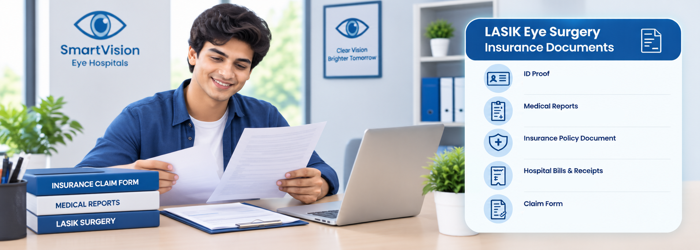
Your Health Insurance Policy Paper or Document
Start with your policy itself. This paper record shows your:
- policy number
- sum insured
- coverage terms
- It also lists any limits related to eye surgery
Read the small print with utmost care. Some policies cover LASIK only after a wait time. Others cover it only for high-power prescriptions above a set eye power. Know your terms first.
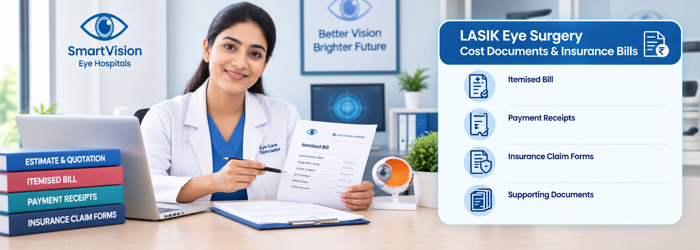
Original Hospital Bills and Receipts
Keep every original bill and receipt from your surgery. This includes:
- Consultation fees
- Pre-surgery test charges
- Surgery charges
- Medicine and supply costs
- Follow-up visit charges
Insurers often reject claims with copies alone. Always ask for original, itemized bills. Ask your clinic to list each charge on its own. Do not accept it as one big lump sum.
Doctor’s Prescription and Referral Letter
- Your eye doctor must provide a written prescription recommending LASIK. This letter should state your current eye power. It should explain why surgery is right for you.
- Insurers ask for this letter to highlight the medical need. It is proof that you are not choosing a cosmetic procedure. Ask your doctor to include specific numbers, like your spherical and cylindrical power in both eyes. Exact eye power will make your case strong.
Pre-Approval Form
This form asks your eye hospital to share details on:
- The procedure done
- The cost estimate
- The medical reason for the surgery
Submit this form well before your surgery date. Do not wait. Cashless claims depend entirely on this step. The medical refund process is lengthy. So be patient. You should have all your papers ready early.
Diagnostic Test Reports
Insurers want proof of your eye condition through proper testing. Gather all your diagnostic reports, including your:
- Eye refraction power test results
- Corneal topography reports
- Pachymetry reports (these measure the cornea thickness and shape)
- Any other pre-surgery eye scans done before
These reports back up your doctor’s advice. They show the insurer that your case fits the rules. It is a medical need, not just personal choice.
Hospital or Clinic Registration Details
- You must have your surgery at a registered and recognized eye hospital. Insurers ask for the hospital’s registration ID. They will also ask for its license papers. Ask your chosen eye hospital for this billing info early. Many top LASIK centres will list these details on their official invoices.
Surgeon’s Qualification Proof or Skill
- Some insurers ask for proof that a licensed eye surgeon did your surgery. The key detail is your surgeon’s medical registration number. It can also include their signed statement confirming all their medical credentials. Your eye hospital should be able to provide this easily. Reputable eye LASIK centres keep this information ready.
Claim Form from Insurer
- Every insurer has its own claim form. Fill it out fully and clearly. Blank spaces and your messy handwriting can cause delays in processing time. Check your policy number, personal details, and bank account info for a quick and smooth medical reimbursement process. Errors here can cause big headaches.
Identity and Policy Proof
Keep your ID proof ready too. This usually includes:
- Aadhar card or PAN card
- Policyholder’s ID card issued by the insurer
- Recent passport-size photographs, if asked
Some insurers ask for these to confirm the patient’s identity matches the policyholder's.
KYC Documents for Refunds
If you are filing a reimbursement claim instead of a cashless one, your insurer needs your bank or KYC details. It includes your:
- Account number
- IFSC code
- Cancelled cheque or Passbook copy
This makes sure your refund reaches the correct account without any delay. Double-check these numbers well before submitting your documents.
Follow-Up Visit Records
LASIK recovery needs follow-up visits. Some insurers ask for this proof to confirm your recovery healing period went okay. It also helps if you need to make claims related to your post-surgery care. Keep records of:
- every post-surgery visit
- any medicines prescribed
- vision test results
Records of Your Eye Power Over Time
- If your plan covers LASIK based on high-power, gather your old prescription records too. Show how your eye power changed over the years. This record of your history supports that your condition is genuine. It is not a sudden decision made for looks.
TPA Message Records
- TPA, or Third-Party Administrator, helps insurers process your claim. Keep records of each mail, letter, or reference number you get from your TPA. If your claim is slow, these proofs can help you follow up fast. Always mark down the date and reference number of each message.
Common Reasons for Claim Rejection Vs Tips for a Smooth Claims Process
Common Reasons for Claim Rejection
- No pre-approval
- Messy or unclear hospital bills
- Treatment at a non-approved eye hospital
- No proof of medical need
- Policy limits that specifically deny elective LASIK
Tips for a Smooth Claims Process
- Submit your documents as a complete set, not in parts, or else it will be paused. Organize your file with clear labels. The insurer or hospital can easily find everything.
- Please keep digital copies in your cloud storage as well. This protects you if any of the papers get physically damaged during the medical refund process.
- Call TPA a few days post-surgery to confirm they received all your files and documents. A quick follow-up catches any missing papers. This keeps your refund on track.
- Review your policy limits before you fix on anything.
Conclusion
Filing a LASIK insurance claim requires patience and careful paperwork. You should gather your documents early. All your prescriptions and discharge summary reports must be ready. Secure all of them digitally as well as in their hardcopy original forms for future safety.
A well-organized claim moves faster through your insurer’s system. Reach out to the help desk in your hospital insurance department if you feel unsure at any step.
Visit our team at Smart Vision Eye Hospitals to secure your future with great sight.
Start your clear future now.
Book your free check today.
Visit our Home Page to learn more. Check Our Doctors page to meet our expert team. Read our About Us page to see our care. Explore our LASIK page for full details.
Contact Smart Vision Eye Hospital now. Your path to clear sight starts here.
Take the first step. Join 12 lakh+ happy patients. Your eyes will thank you.