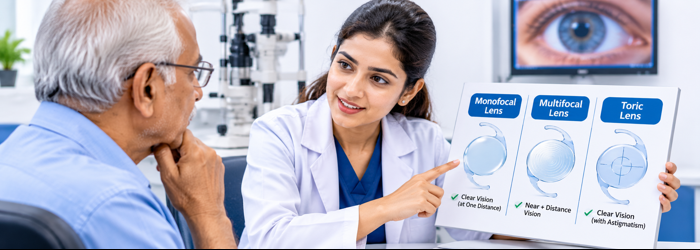
Imagine having control over your vision and seeing the world clearly whether you’re reading signs or choosing from different types of glasses. Because of continuous improvements in cataract surgery, you can do all of this.
It all comes down to one thing: the lens. It is the artificial lens that you will have. The intraocular lenses used in this process differ.
The blog provides you with the basic types of IOLs that you may opt for. You will learn about their effectiveness and gain useful information on how to select the best type of IOL for yourself.
Book An Appointment
What Are the Different Cataract Lens Types Used in Cataract Eye Surgery?
What Does an IOL Do?
- Your natural lens focuses light rays onto the retina, the thin light-sensing tissue at the back of your eye. Cataracts prevent your natural lens from producing sharp vision because it is clouded. Surgery helps remove the cloudy lens. In this way, the IOL takes over its job.
Monofocal Lenses: The Trusted Standard
- Monofocal lenses are the most popular lenses. They focus light on one distance. Many people choose distance vision. This lets you see clearly while driving, walking, or watching television, but you’ll need reading glasses for close-up tasks.
- Some people choose one eye for focusing on far objects and the other eye for focusing on near objects. This is known as monovision. It reduces your dependency on glasses. However, you will require time to adapt to it.
- Monofocal lenses have several advantages. They provide clear and sharp vision. There are fewer halos at night when using them. They are usually covered by insurance.
Toric Lenses: A Fix for Astigmatism
- If you have astigmatism, then you have a problem where the shape of the cornea is uneven. It’s shaped like a football rather than a basketball, and vision becomes blurred. Toric lenses solve this problem. They have built-in angles that compensate for this uneven shape. But this means that the placement of the lens is critical. So, you need to mark your eye before the operation.
- Toric lenses can be either single-focus lenses or multi-focus ones. It will cost you extra. But in exchange for this, you should see well enough to wear glasses or even no glasses at all.
Multifocal Lenses: Sight at Many Distances
- Multifocal lenses will split light into several focal points from which the brain chooses one. Trifocal lenses do this as well; they cover far-sight, mid-range, and near-sight vision.
- For the first few weeks, you will experience increased sensitivity to light. This will result in seeing bright circles around objects. But gradually the brain will learn to disregard these visual effects. Usually, this takes several months.
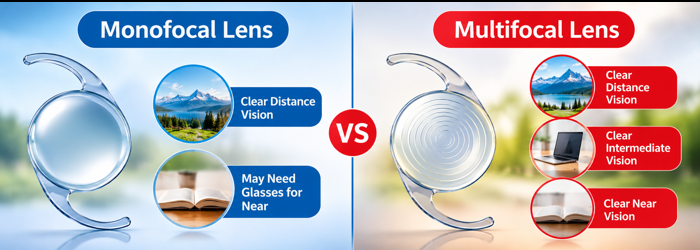
Monofocal vs Multifocal IOL: Which Cataract Lens Is Right for You?
Monofocal VS Multifocal IOL
- Both lenses give sharp far vision. For near vision, Monofocal needs glasses. Multifocal lenses tend to cause less glare at night, while monofocal lenses can cause more.
- Monofocal lenses also offer better contrast than the other two options. They cost less and are often covered by health insurance. The second costs more, and plans rarely pay for it.
Cost Factor
- The prices fluctuate widely by city, hospital, and lens brand name. All of them should be treated only as guidelines. Standard phaco surgery with a Monofocal lens in a private hospital normally costs from ₹20,000 to ₹60,000 per eye. Surgery with the basic Monofocal lens begins at ₹15,000. Top-end lenses like multifocal add about ₹30,000-₹1,00,000 per eye to the price. Twice that for two eyes. Depends on the manufacturer of the lens too; foreign lenses are slightly more expensive.
- Get a quotation in writing from each hospital and understand its contents carefully.
Health Plans
- Conventional cataract surgery and monofocal lenses are insured by the health plan. Insurance companies normally see advanced lenses as an improvement; therefore, you pay an extra cost for this improvement. Hence, it becomes important for you to study your insurance plan before getting surgery. Make sure that there are no restrictions on it.
Five Life Factors that Influence the Choice
- Diabetes: Most individuals have problems like diabetes. This can damage the retina. Multifocal lenses require a healthy retina. Multifocal lenses are not recommended for diabetic retinopathy. It is advised that first of all get your retina examined.
- Dust and dry eye: Urban pollution causes drying of the eye. Dry eyes may lead to blurred vision, which further affects multifocal implants. Therefore, it is best to get rid of this problem beforehand.
- Night driving: The roads are full even at night, especially in metropolitan cities. In such conditions, stress caused by unlit and brightly lit vehicles increases. Multifocal lenses will cause more trouble in such situations. Hence, monofocal lenses would be a better choice.
- Phone and screen time: We all live on our phones these days. Texting requires near-vision work. Don’t like changing glasses? Multifocal lenses can solve that problem.
- Budget: Face reality about your financial situation. It's better to get an affordable lens with glasses than an expensive lens that breaks the bank. Technical skills matter more than cost.
Who Should Choose Monofocal VS Multifocal IOL?
Monofocal may suit you if:
- You regularly drive at night.
- You have diabetes, glaucoma, or macular problems.
- You wish to get the best-tested, least expensive choice.
- You are okay with wearing reading glasses.
Multifocal may suit you if:
- You don’t like glasses.
- Your eyes are healthy.
- You usually drive during the daytime.
- You can tolerate some halos at night
Watch Out for Hype
Some eye hospitals strongly promote expensive top-end lenses. There could be unrealistic and even deceptive marketing going on. A reputable surgeon should discuss both options with you. They will tell you what they involve.
You are never supposed to feel pressured. Ensure you do not rush to make a choice; you can seek a second opinion when in a rush.
There is a common myth that the expensive premium nature of the lens means better vision. Any properly fitted mono-lens is better than an improperly fitted multi-lens.
Fitting should always take precedence over cost.
Consider Smart Vision Eye Hospitals for expert advice and consultation on lenses. We have professionals with great experience who will ensure you get the best FDA-approved US technology for your eyes.
You Decide in Three Simple Steps
- Step 1: List your daily tasks. Do you read or work on a screen? Do you drive at night?
- Step 2: Get a full eye check done. Ask if your eyes can handle a multifocal lens.
- Step 3: Talk about the numbers. Ask for the full price of each option, in writing, always.
Set Real Expectations
Nevertheless, irrespective of how advanced the lenses are, they won't do anything good for any eye problem apart from cataracts. You should give your eyes a week or two to adjust to new lenses, and once this period is over, you will like the results as everybody does.
Initially, make sure you protect your lenses by sticking to the instructions. Use all the needed drops and go to all the appointments.
Conclusion
Now you have a good chance thanks to surgery for cataracts. You have a real opportunity to restore your eyes and appreciate life from a different perspective. Monofocal, toric, multifocal, and other lenses can serve people for various purposes.
Make sure you tell everything about your medical history to your doctor, giving him/her only true information. Follow your surgeon's instructions when picking a cataract lens type.
You are in good hands, with personalized care, top-notch equipment, and a dedicated team focusing on your safety at every step. Smart Vision Hospitals is the go-to choice for thousands of patients who appreciate our straightforward advice and real results. See your world clearly and brightly. Make Smart Vision your smart choice for the future.
Book your consultation today and take the first step toward clear vision!
Visit Smart Vision Eye Hospitals to win your chance at renewed vision with SMILE LASIK.
Are you ready to embark on your journey to clearer and brighter vision?
Visit our branches at Smart Vision Eye Hospitals and ask your questions. Book your first time consultation for free now!
Start your clear future now.
Book your free check today.
Visit our Home Page to learn more. Check Our Doctors page to meet our expert team. Read our About Us page to see our care. Explore our LASIK page for full details.
Contact Smart Vision Eye Hospital now. Your path to clear sight starts here.
Take the first step. Join 12 lakh+ happy patients. Your eyes will thank you.