If you are having problems with your vision, cataracts may be one possible cause. They affect many people each year. Cataracts are among the leading causes of vision loss in older adults globally. Cataracts can develop in different parts of the lens. The different types of cataract may progress at a different rate and cause different symptoms. This article covers the main types.
Book An Appointment
What Are the Different Types of Cataracts? Understanding Nuclear, Cortical & Other Types
What Exactly Is a Cataract?
The lens sits behind the iris and is made mostly of water and proteins. When you are young, the proteins are neatly arranged. They help in keeping the lens clear. As we age, some proteins can clump together, forming cloudy patches that gradually grow over time. These cloudy patches block light and make vision blurry. Eye care professionals classify cataracts according to where the cloudy areas form in the lens.
Nuclear Cataracts
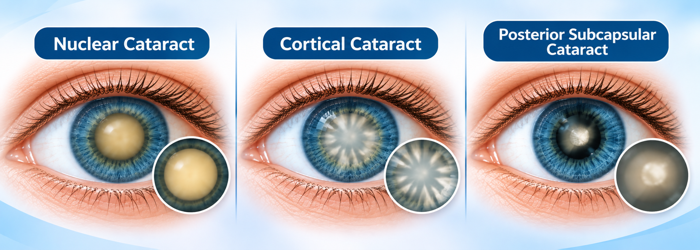
- These cataracts develop in the central part of the lens and are called nuclear cataracts. They’re the most common type associated with aging.
- They tend to develop gradually, so symptoms may not appear for quite some time. At first, vision may seem to improve. It can be a change known as “second sight.” Over time, the lens nucleus turns yellow and may eventually become brown. Colors and objects may become harder to see clearly, particularly at a distance, and reading small print can also become difficult.
- Nuclear cataracts usually affect both eyes, though one eye may be more affected than the other. If they significantly impair vision, surgery may be an option. The surgeon removes the cloudy lens and replaces it with a new one.
Cortical Cataracts
- Cortical cataracts develop in the lens cortex, the outer part of the lens. One common sign is the appearance of white lines. These begin at the edge of the lens and gradually extend towards its centre, like spokes radiating from a hub.
- This type of cataract can cause several problems, including glare. Headlights may seem brighter. Your colour perception and contrast sensitivity may decrease significantly.
- People with diabetes are in the danger zone. They may be more likely to develop cortical cataracts because diabetes can damage the lens. How quickly cataracts progress varies for each unique individual.
- Cortical cataracts can affect vision in different ways. Some areas may remain clear, while others appear blurry. So, no guesswork helps for patients at home. An eye check-up is mandatory.
Posterior Subcapsular Cataracts
- Posterior subcapsular cataracts grow at the rear of the lens. They lie right under the lens capsule. This is the thin outer layer of the lens.
- Posterior subcapsular cataracts develop rapidly. They can develop within months, not years. That’s much quicker than nuclear or cortical types.
- These particular cataracts lead to some specific problems. First, you will have difficulty reading quickly. Second, there is glare in bright light. Third, your close vision is affected more than your far vision.
- Some of the factors that make you prone to having this kind of cataracts are long-term use of steroids and diabetes.
- Younger patients get this type more often than the slow-growing nuclear kind.
Congenital Cataracts
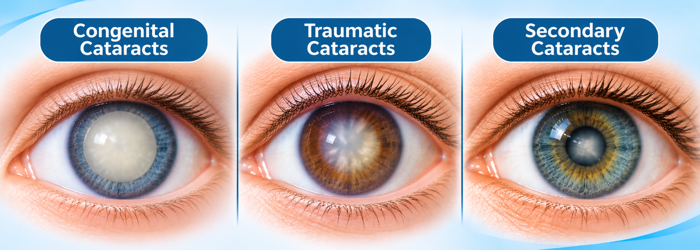
- Not all cataracts come with age. Some babies are born with cloudy lenses. The headlights from motor vehicles may appear brighter, and there could be a large reduction in contrast sensitivity.
- There could be a possibility that people with diabetes tend to have cortical cataracts since diabetes increases the chances of damage to the lens. The rate at which cataracts progress may vary from one individual to another.
- The visual difficulties that arise due to cortical cataracts may vary. An individual with this condition may have clear vision in some areas, but blurry vision in other areas.
Traumatic Cataracts
- An eye injury can also cause a cataract. This is called a traumatic cataract. Injuries such as impacts to the eye or an electrical shock can cause the appearance of a cataract after the injury happens. Sometimes the cataract appears right after the injury. Other times, it takes months or even years to develop.
- Lens damage causes the same disruption in protein structure as age-related cataracts. Causes of lens damage include sports injuries, workplace accidents, car accidents, etc. Using eye protection during dangerous activities reduces this risk.
Secondary Cataracts
- Secondary cataracts can be caused by certain medical conditions and medications.
- There can be other diseases of the eye that lead to their appearance. One of the main ones is diabetes. High levels of blood sugar change the composition of your lens.
- Secondary cataracts can also result from other eye diseases like glaucoma.
- Symptoms of various types of cataracts are similar even if the types differ slightly in character or how they are caused.
Common Symptoms and Diagnosis of Different Cataract Types
Common Symptoms Across Cataract Types
While each type has its quirks, some symptoms overlap. Watch for these signs:
- Blurry or cloudy vision
- Trouble seeing at night
- Sensitivity to light and glare
- Halos around lights
- Fading or yellowing colours
- Frequent changes in your glasses prescription
- Double vision in one eye
If any of these symptoms appear, you need to make an appointment for an eye checkup. It is important because the earlier the disease is diagnosed, the more efficiently the medical specialist can track it.
Diagnosis of Various Types of Cataract
- Moreover, an ophthalmologist performs a vision test to see how clear your vision is. With a slit lamp, he/she can observe your lens under magnification. Thus, based on the results, a physician knows what kind of cataract the eye surgeon has to deal with. It plays a significant role in choosing the right time for the surgery.
Conclusion
It is necessary to mention that there are different types of cataracts. All of them have their peculiarities of development. The nuclear cataract appears slowly over time.
Therefore, the cortical cataract causes blurry vision and problems with viewing nearby and distant objects. The rest of the types of cataracts appear because of various diseases, injuries, and genetics. Visit Smart Vision Eye Hospitals now!
You are in good hands, with personalized care, top-notch equipment, and a dedicated team focusing on your safety at every step. Smart Vision Hospitals is the go-to choice for thousands of patients who appreciate our straightforward advice and real results. See your world clearly and brightly. Make Smart Vision your smart choice for the future.
Book your consultation today and take the first step toward clear vision!
Visit Smart Vision Eye Hospitals to win your chance at renewed vision with SMILE LASIK.
Are you ready to embark on your journey to clearer and brighter vision?
Visit our branches at Smart Vision Eye Hospitals and ask your questions. Book your first time consultation for free now!
Start your clear future now.
Book your free check today.
Visit our Home Page to learn more. Check Our Doctors page to meet our expert team. Read our About Us page to see our care. Explore our LASIK page for full details.
Contact Smart Vision Eye Hospital now. Your path to clear sight starts here.
Take the first step. Join 12 lakh+ happy patients. Your eyes will thank you.