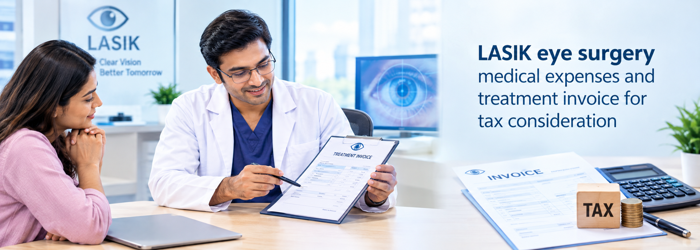
Picture this. You just booked your LASIK surgery in Delhi. You feel excited. No more glasses or contact lenses. Then a thought hits you. LASIK costs from 40,000 to 1,20,000 Indian rupees. Can you claim that on your tax return?
It is a fair question. We all love finding legal ways to save tax. But when it comes to LASIK, the answer might surprise you. This blog explains the tax rules in plain words. It also shows you smart ways to cut the cost.
Book An Appointment
Is LASIK Eye Surgery Eligible for Tax Benefits in India?
The Quick Answer: No Direct Tax Deduction
- Here is the truth. LASIK surgery does not get a direct tax deduction under Indian law. The Income Tax Department treats it as an elective, personal expense, not a medical necessity.
- This fact can shock people. Most folks assume that any medical procedure counts as a deduction. It does. Let us see why LASIK misses the mark.
Why Section 80D Does Not Help Either
- Section 80D gives a deduction for some diseases. These sit on a fixed list, called Rule 11DD. The list has cancer, kidney failure, and some brain conditions.
- LASIK is not on the list. The law made this rule for serious illnesses. Clear vision helps your daily life. But it does not meet that bar. LASIK remains hard to claim here, too. After all, it deals with medical expenses.
- A direct tax deduction will not work. So, let us look for ways and plans that will save you from your financial burdens.
Why Section 80DDB Does Not Help Either
- Section 80DDB offers deductions for specified diseases under Rule 11DD, such as cancer, kidney failure, and certain neurological conditions. LASIK is nowhere to be found on the list.
- The government designed 80DDB for serious, often life-threatening illnesses. Vision correction, no matter how much it improves your daily life. just does not meet the bar under the tax code. LASIK tax benefits are tricky to get by.
- Since direct tax deductions will not help you here, try focusing on the medical expense deduction strategies that actually reduce your costs.
Can LASIK Surgery Cost Be Claimed as a Medical Expense Deduction?
Can Self-Employed Professionals Claim LASIK as a Business Expense?
- According to Section 37(1) of the Income Tax Act, a business expense needs to be incurred solely and exclusively for your profession. However, your eyesight is considered a personal asset, not a business one. This means that even professionals like photographers, pilots, and surgeons who all rely on sharp vision for their work cannot claim LASIK surgery as a business expense.
What if Your Employer Pays for LASIK?
- Some progressive companies now include LASIK under a medical expense deduction. It sounds great, but it really is not that simple.
- Even when your employer pays the bill, the amount is often added to your salary as a taxable benefit. So, you still have to pay income tax on it, just in a different way. Ask your HR team how they structure this benefit before making any assumptions that it’s tax-free.
Does Health Insurance Cover LASIK?
- This is where you can relax a bit. Many health insurance providers in India now cover LASIK, but only under certain conditions. Your refractive error typically needs to be around 7.5 Diopters. Hence, the procedure must be medically necessary rather than fully cosmetic.
- Insurers also apply waiting periods before the coverage kicks in. If your policy includes LASIK, your out-of-pocket cost drops significantly, but this does not mean it becomes a separate tax deduction. It simply reduces the bill that you had to otherwise pay in full.
- Before your surgery, call your insurer and ask two things:
- “Does your policy cover refractive surgery?”
- “What diopter threshold applies?”
- This small call can save you thousands of rupees.
.

Realistic Ways to Ease the Financial Burden
Explore employer flexible benefit plans
- Some companies structure salaries with flexible benefit components. Ask your payroll or HR department if any part of your compensation structure can route through a medical or wellness allowance. Note that most such reimbursements now get taxed as part of your salary. So, you need to confirm the actual benefit before you make the final call to be dependent on it.
Use low-cost EMI Options
- Many LASIK clinics partner with banks to offer low-cost or no-cost EMI options. You spread your payment over several months without extra interest charges. This does not reduce your tax, but it will ease your cash flow.
Check corporate wellness programs
- These days, many companies are getting on board with wellness benefits or teaming up with healthcare providers. It might be worth checking in with your HR team to see if your company has any discounts available for elective procedures like LASIK.
Compare clinics and technology options
- The cost of a LASIK procedure varies a lot between clinics and cities. Compare multiple LASIK providers before you commit. Ask about combo offer packages that include a bit of pre-surgery testing and frequent follow-up visits.
Time your surgery around discounts
- Time your surgery around bonus or refund periods. If you expect an annual bonus or a tax refund, you might plan your surgery around that time. This is not a tax strategy, but it helps you manage your budget better.
Documentation You Should Still Keep
Even though LASIK does not directly reduce your taxable income, always keep your paperwork organized. The medical expense deduction is a long process, so keep your:
- Itemized surgery bill
- Payment receipts or
- Any pre-surgery medical reports
Such documentation helps if tax rules change in the future, and it also matters if you ever need to file an insurance claim related to your eye health.
When LASIK May Indirectly Help Your Taxes
In some rare cases, if your ophthalmologist certifies that your vision impairment stems from a condition listed under 80DDB’s specified list, or if it relates to a disability certified under Section 80U or 80DD. Then you have some ground to apply for or explore a claim.
This is applicable only in unusual medical situations. When it comes to common refractive errors like myopia or hypermetropia, it is important to get the right certification from a qualified medical professional before moving forward. Also, get confirmation from a tax professional to confirm your eligibility.
Final Thoughts
LASIK surgery does not get a direct income tax deduction under our Indian tax laws. Section 80D covers only insurance premiums. Section 80DDB covers a fixed list of diseases only. Neither one covers routine vision correction surgery.
The old employer medical reimbursement rule no longer helps. A flat standard deduction took its place back in 2018.
Before you assume a tax benefit applies to you, ask a chartered accountant. Tax laws shift with each budget cycle. One bright spot: no GST applies to healthcare services. So your bill stays lower than it would for other paid services. With smart planning, you can still make LASIK affordable, even without a direct tax break.
Smart Vision Eye Hospitals offers exciting LASIK options, so keep an eye out for them!
Visit our team at Smart Vision Eye Hospitals to secure your future with great sight.
Start your clear future now.
Book your free check today.
Visit our Home Page to learn more. Check Our Doctors page to meet our expert team. Read our About Us page to see our care. Explore our LASIK page for full details.
Contact Smart Vision Eye Hospital now. Your path to clear sight starts here.
Take the first step. Join 12 lakh+ happy patients. Your eyes will thank you.