PRK: Proven Vision Correction Without a Flap
What is PRK?
PRK stands for Photorefractive Keratectomy. It's a type of laser eye surgery. It fixes vision problems like:
- You can't see far away (near-sighted)
- You can't see up close (farsighted)
- Blurry vision at all distances
PRK was the first laser-based vision correction procedure. It came before LASIK. It's still used today because it works so well. Many doctors choose PRK for themselves.
Book An Appointment
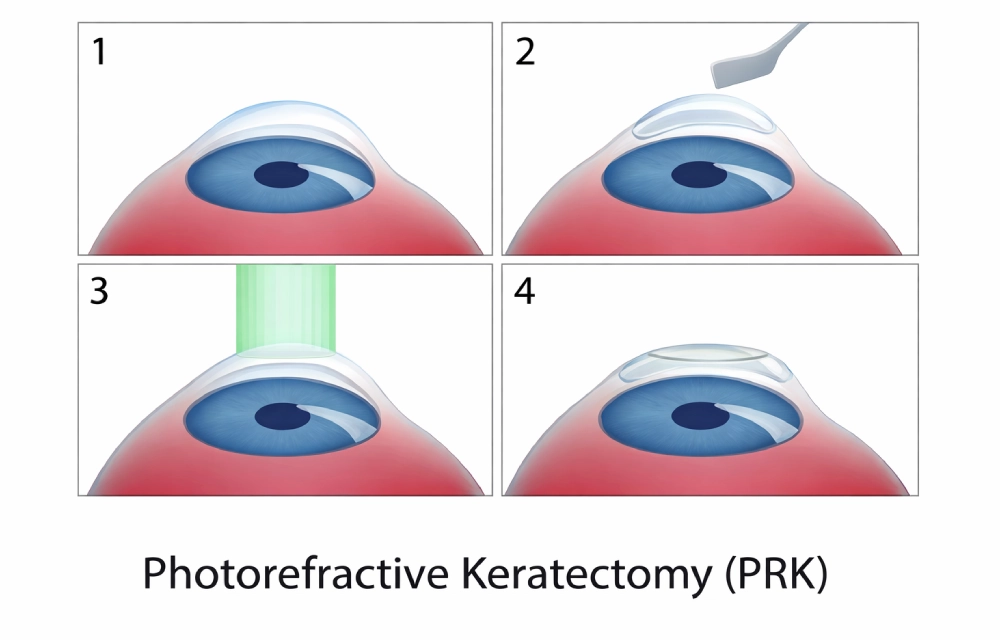
How Does PRK Work?
The surgery is remarkably simple and direct. The laser part takes only 5-10 minutes per eye.
Step 1: Remove Surface Layer
The doctor gently removes the thin surface layer of your eye (the epithelium). In a few days, it completely regrows on its own naturally.
Step 2: Reshape Your Eye
A highly precise laser reshapes the tissue below to fix your vision. The laser tracks your eye movements and works in mere seconds.
Step 3: Bandage Lens
A special contact lens goes on your eye to act as a clear bandage. It stays on for 3-5 days to keep you comfortable while healing.
Why Choose PRK?

No Flap Created
PRK does not cut a corneal flap. This makes your eyes much stronger and eliminates flap-related complications.
Safest for Active
Perfect if you play contact sports or have a physical job. No flap means nothing can ever shift or move later.
For Thin Corneas
If you were told your corneas are too thin for LASIK, PRK is often the perfect alternative as more tissue is left intact.
Military Approved
Approved and standard for military pilots and special forces, proving its incredible safety and long-term durability.
Excellent Vision
PRK gives the exact same great visual results as LASIK. Studies show equal long-term clarity and quality.
Less Dry Eye
Compared to LASIK, PRK causes significantly less dry eye because more superficial corneal nerves stay intact.
What Can We Expect Following Surgery?
PRK requires a bit more patience during healing, but the lifelong results are worth it.
First Few Days
- Eyes feel gritty/uncomfortable
- Vision will be quite blurry
- You may feel light sensitivity
- Stay home, rest, use drops
- Bandage lens stays on
First Week
- Discomfort fades in 3-4 days
- Vision starts to noticeably improve
- Bandage lens removed (~Day 5)
- Can return to light work
- Keep avoiding heavy screens
First Month
- Vision improves dramatically
- Drive and work normally
- Minor light haziness is normal
- Attend scheduled checkups
- Resume light exercise
3-6 Months
- Final crisp results become clear
- Most see 20/20 or better
- All activities fully resume
- Vision stabilizes completely
Are You a Good Fit?
PRK may be your ideal choice if:
- You are 18 years or older
- Your prescription is stable for a year
- You have thinner corneas
- You play heavy contact sports
- You have a physical/military career
- You can take a few days to recover
Should I get LASIK or PRK?
Your lifestyle, cornea thickness, and eye health will determine this.
| Choose PRK if: | Choose LASIK if: |
|---|---|
|
|
How do I prepare?
Stop wearing contacts before your visit:
- Soft lenses: Remove 1-2 weeks prior
- Hard lenses: Remove 3-4 weeks prior
Arrange time off work. Plan to rest for several days. Get help at home for the first few days. Stock up on your prescribed eye drops and follow all clinical instructions.
What are the risks?
Like any surgery, there are small risks:
- Haze during healing (usually goes away)
- Under-correction or over-correction
- Infection (very rare)
- Prolonged discomfort (rare)
- Regression (vision slowly changes back, rare)
Your doctor will discuss all risks with you in full detail.
Frequently Asked Questions
The surgery itself does not hurt at all. We use powerful numbing eye drops. You will feel no pain during the procedure, though you may feel minor discomfort during the healing days at home.
PRK recovery is slower than LASIK. Vision is very blurry for the first few days. It starts improving after 5-7 days. Most people can drive and work after 1-2 weeks. Final, perfect vision takes 1-3 months. Be patient - the pristine results are worth the wait!
Yes, PRK is extremely safe. It's been performed successfully since the 1980s. Millions of procedures have been done globally. It's considered the safest option for highly active people and is strictly trusted by the military for pilots.
Instead of cutting a deep flap (like LASIK), PRK removes the microscopic top layer. This layer needs to naturally grow back (3-5 days) and then smooth out over several weeks. While the healing takes longer, the lack of a flap makes the eye structurally stronger for life.
Yes! PRK is exceptionally accurate for fixing astigmatism. It reshapes the cornea into a perfect curve, completely correcting all levels of astigmatism.
Yes, doing both eyes on the same day is the standard. It means you only have to go through one recovery period, though it does mean you will need to rely on someone else for help during the first 3 days of blurry vision.
This depends entirely on your job. Light desk work: 3-5 days. Heavy computer jobs: 5-10 days (you will need breaks). Physical labor or dusty environments: 1-2 weeks. We recommend taking the time necessary to let your eyes heal safely.